
 Post by
 Google June 2026 Spam Update
In pursuit of this end, Google is always making adjustments to its search algorithms and the algorithms of its other services. The Google June 2026 Spam Update is once again a significant move in Google’s never-ending pursuit to demote spam from their search results and reward sites that offers real value. If you have a business website, an ecommerce shop, a travel portal or a local service business, this update will help you understand what you can do to protect and possibly improve your visibility in search. In this post, we’ll cover: What the June 2026 Spam Update means Who is impacted How you can ensure your website is compliant with Google’s best practices.
What Is the Google June 2026 Spam Update?
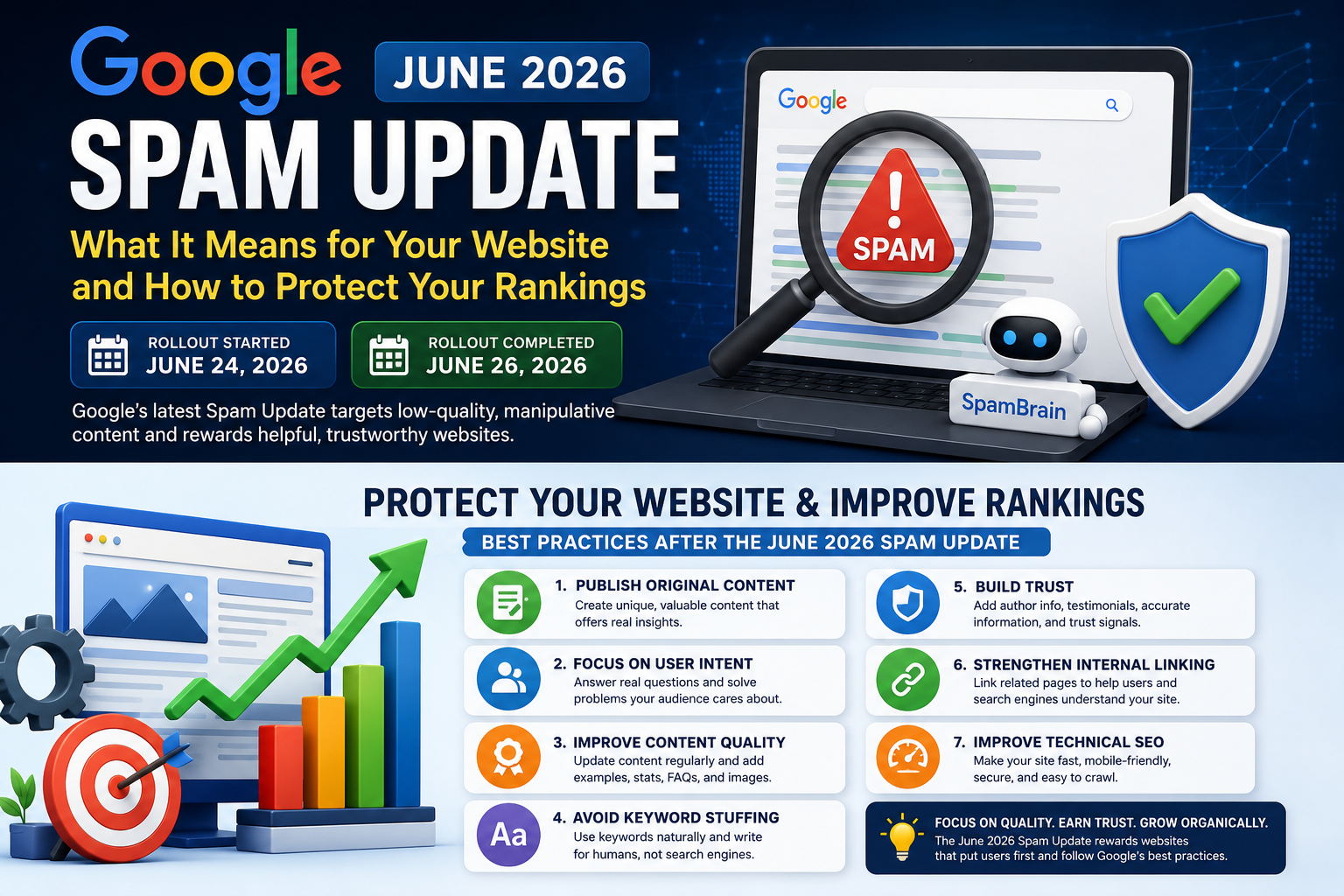
The Google June 2026 Spam Update is an official algorithm update focused on improving Google’s ability to identify and reduce spammy content in search results. The rollout began on June 24, 2026, and completed on June 26, 2026.
Unlike a Core Update, which broadly evaluates content quality, a Spam Update specifically targets websites that attempt to manipulate search rankings through deceptive or low-quality SEO tactics.
The goal is simple: provide users with more trustworthy, relevant, and useful search results.

Why Google Released This Update
Google’s mission is to organize the world’s information and make it universally accessible and useful. To achieve this, Google continuously improves its spam detection systems to prevent low-quality websites from outranking helpful ones.
The June 2026 Spam Update reinforces Google’s commitment to rewarding websites that publish authentic, user-focused content while reducing the visibility of pages created solely to manipulate rankings.
What Types of Content Were Targeted?
Although Google did not publish a complete list of ranking signals, SEO experts observed increased scrutiny of websites that relied on manipulative practices such as:
- Mass-produced AI-generated content with little or no human review
- Thin pages offering minimal value
- Duplicate or copied content
- Keyword stuffing
- Doorway pages designed only to rank for specific searches
- Hidden text or cloaking
- Link schemes and unnatural backlink profiles
- Scaled content created primarily for search engines instead of users
These tactics may temporarily boost rankings but often lead to long-term losses when Google updates its spam detection systems.
The way DS Solution complements us by always looking for the solution that provides the most value for our business case, makes DS Solution the ideal partner. One that really helps us achieve our goals. Partly because of this, we look confidently at the future and our cooperation.
Which Websites Were Most Affected?
The update primarily impacted websites that relied on shortcuts rather than quality.
Examples include:
- Affiliate websites with copied product descriptions
- Travel websites publishing generic destination pages without original insights
- AI-generated blogs lacking expertise or fact-checking
- Local business websites filled with duplicate location pages
- Sites using purchased backlinks or private blog networks (PBNs)
- Automatically generated landing pages with little useful information
On the other hand, websites producing original, helpful, and trustworthy content generally maintained or improved their visibility.
How Google Defines Helpful Content
Google increasingly rewards content that demonstrates:
- First-hand experience
- Subject matter expertise
- Accuracy and trustworthiness
- Original research or insights
- Clear answers to user questions
- Regular updates to keep information current
Instead of writing for search engines, businesses should focus on solving real customer problems.
How to Protect Your Website
If you want your website to perform well after the June 2026 Spam Update, follow these best practices.
1. Publish Original Content
Avoid copying content from competitors or relying entirely on AI-generated articles. Add your own expertise, examples, images, and unique insights.
2. Focus on User Intent
Every page should answer a specific question or solve a problem. Think about what visitors genuinely want to know rather than simply targeting keywords.
3. Improve Content Quality
Review older pages regularly and update outdated information. Add FAQs, statistics, examples, visuals, and actionable advice to make your content more valuable.
4. Avoid Keyword Stuffing
Use keywords naturally within headings and body text. Prioritize readability over keyword density.
5. Build Trust
Include author information, contact details, business credentials, customer testimonials, and accurate citations where appropriate. Trust signals help users and search engines.
6. Strengthen Internal Linking
Connect related articles and service pages so users can easily find additional information while helping search engines understand your site’s structure.
7. Improve Technical SEO
Ensure your website is:
- Mobile-friendly
- Secure (HTTPS)
- Fast loading
- Easy to navigate
- Free from broken links and crawl errors
Technical performance contributes to a better user experience.
Should You Be Worried About AI Content?
Not necessarily.
Google has repeatedly stated that it does not penalize content simply because AI helped create it. The issue is quality, not the method of creation.
If AI-generated content is thoroughly reviewed, fact-checked, enhanced with expert insights, and written to genuinely help users, it can perform well. Problems arise when businesses publish large volumes of low-quality, repetitive, or inaccurate content without human oversight.
Recovery Tips if Rankings Dropped
If your rankings declined after the update:
- Audit your content for quality and originality.
- Remove or improve thin pages.
- Replace duplicate content with unique information.
- Review your backlink profile and remove manipulative links if necessary.
- Improve E-E-A-T (Experience, Expertise, Authoritativeness, and Trustworthiness).
- Update older blog posts with current information and practical examples.
- Monitor Google Search Console to identify indexing or performance issues.
Recovery takes time, but consistent improvements can restore visibility over future algorithm updates.
Final Thoughts
The Google June 2026 Spam Update is another reminder that sustainable SEO depends on providing genuine value to users. Businesses that invest in high-quality content, technical excellence, and trustworthy user experiences are more likely to achieve lasting search success.
Rather than chasing quick ranking wins, focus on building a website that educates, informs, and helps your audience. Google’s algorithms continue to evolve, but helpful, original, and reliable content remains the strongest foundation for long-term organic growth. For more information at DS Solution.