
 Post by
The digital search landscape has evolved dramatically over the past few years. Users are no longer limited to typing short keywords into search engines. Today, millions of people use voice assistants like Google Assistant, Siri, Alexa, and AI-powered search tools to ask complete questions in natural language.
Instead of searching for:
- “SEO company”
- “Digital marketing agency”
Users now ask:
- “Which SEO company can help my business rank higher on Google?”
- “Who offers affordable digital marketing services near me?”
- “What is the best SEO strategy for small businesses?”
This shift has transformed how businesses should approach search engine optimization.
Voice Search SEO is no longer simply about ranking for keywords—it is about delivering clear, conversational, and authoritative answers that search engines and AI assistants can easily understand.
At DS Solution, we help businesses build modern SEO strategies that improve online visibility, increase qualified traffic, and generate measurable business growth.
In this guide, you will discover advanced voice search SEO strategies that can help your website stay competitive in today’s AI-driven search environment.

What Is Voice Search SEO?
Voice Search SEO is the process of optimizing your website so that search engines and voice assistants can quickly identify and deliver your content as the best answer to spoken queries.
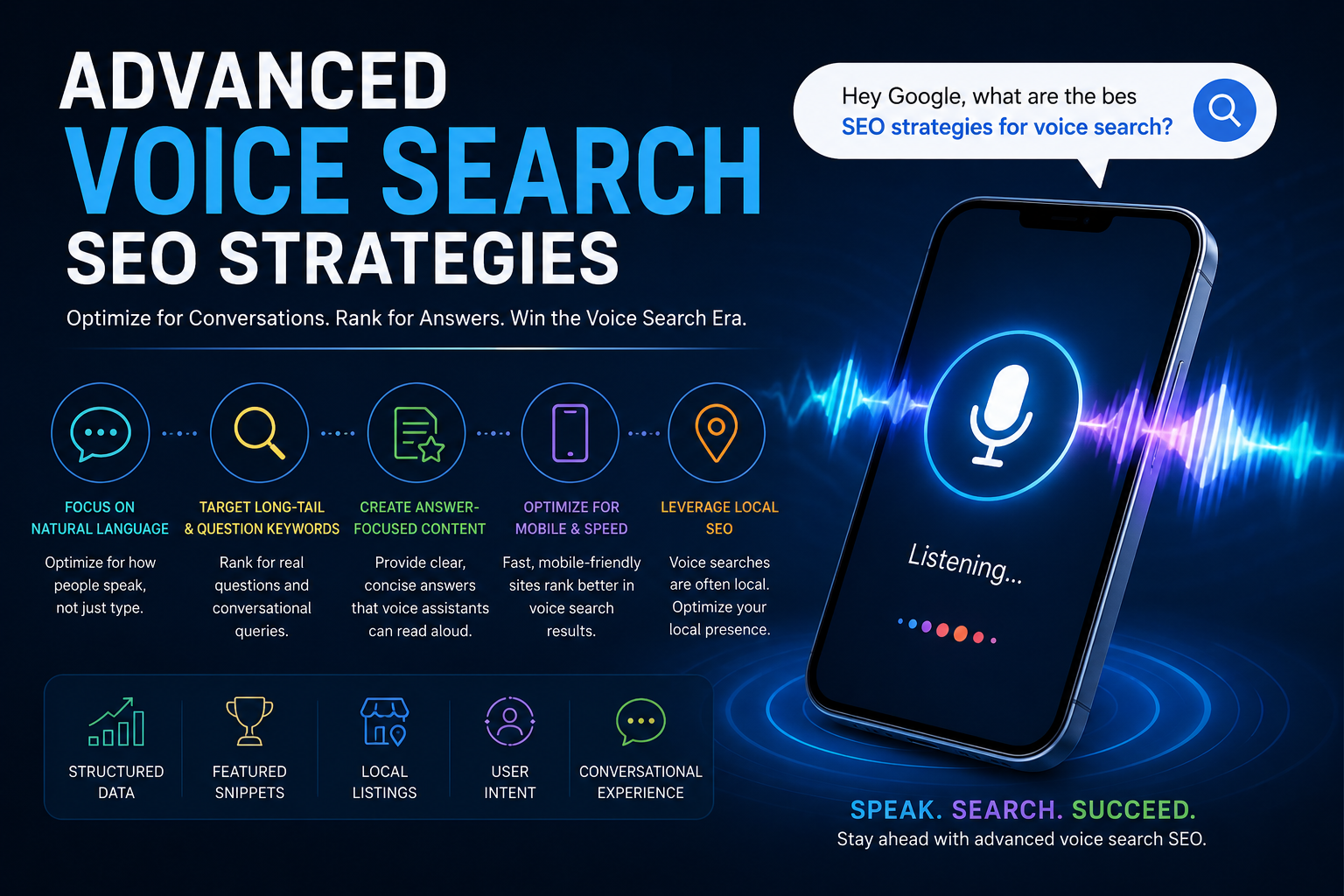
Unlike traditional SEO, voice optimization focuses on:
- Conversational language
- Question-based content
- User intent
- Local search optimization
- Mobile usability
- Structured data
- Fast-loading websites
As AI-powered search becomes more sophisticated, businesses that provide helpful, well-structured information are more likely to earn visibility.
Why Voice Search Matters
Consumers increasingly rely on voice search because it is faster and more convenient.
Common voice searches include:
- “Where can I find an SEO agency near me?”
- “How does local SEO work?”
- “What is the cost of SEO services?”
- “Which digital marketing company has the best reviews?”
These searches often indicate strong purchase intent, making voice optimization an important lead-generation strategy.
1. Optimize for Conversational Keywords
Traditional keyword targeting is no longer enough.
People naturally speak differently than they type.
Instead of targeting:
- SEO Agency
- Digital Marketing Services
Focus on phrases like:
- How can I improve my Google rankings?
- Which SEO agency is best for small businesses?
- What is the fastest way to increase website traffic?
Use tools like Google’s “People Also Ask,” customer support questions, and sales conversations to identify natural-language search opportunities.
2. Build Topic Clusters Instead of Individual Blogs
Modern SEO rewards topical authority.
Rather than creating isolated articles, organize your content into interconnected topic clusters.
Example:
Pillar Page
Complete Guide to SEO
Supporting articles:
- Local SEO
- Technical SEO
- Voice Search SEO
- AI SEO
- On-Page SEO
- Off-Page SEO
- Content Marketing
- Link Building
Internal links between these pages help search engines understand your expertise while improving user navigation.
3. Target Featured Snippets
Many voice assistants read answers directly from Featured Snippets.
Increase your chances by:
- Answering questions within the first 40–60 words
- Using bullet lists
- Creating numbered steps
- Adding concise definitions
- Including comparison tables
For example:
What is Voice Search SEO?
Voice Search SEO is the practice of optimizing website content so it can answer spoken search queries using natural language, structured information, and mobile-friendly experiences.
4. Create High-Quality FAQ Sections
Frequently Asked Questions are among the most effective assets for voice optimization.
Include questions such as:
- What is Voice Search SEO?
- Why is voice search important?
- How does AI impact SEO?
- How can local businesses optimize for voice search?
- What are the benefits of structured data?
Each answer should begin with a short, direct explanation followed by more detail.
5. Improve Website Speed
Voice users expect immediate answers.
Slow-loading websites can reduce engagement and conversions.
Improve performance by:
- Compressing images
- Enabling browser caching
- Reducing unnecessary scripts
- Using a Content Delivery Network (CDN)
- Optimizing Core Web Vitals
Fast websites create better user experiences and support stronger search visibility.
6. Prioritize Mobile Optimization
Most voice searches occur on smartphones.
Your website should include:
- Responsive layouts
- Readable typography
- Fast loading times
- Simple navigation
- Click-to-call buttons
- Easy-to-complete contact forms
Mobile-first optimization remains essential because search engines primarily evaluate the mobile version of websites.
7. Implement Structured Data
Schema markup helps search engines better understand your content.
Useful schema types include:
- Organization
- LocalBusiness
- Service
- FAQPage
- Article
- Breadcrumb
- Review
Structured data can increase eligibility for rich results and improve how content is interpreted by search engines and AI systems.
8. Strengthen Local SEO
Many voice searches have local intent.
Examples include:
- SEO company near me
- Digital marketing agency nearby
- Website designer in Dallas
- Local SEO expert in Houston
To improve local visibility:
- Keep your business information consistent.
- Optimize your Google Business Profile.
- Encourage authentic customer reviews.
- Create location-specific landing pages.
- Include local keywords naturally within your content.
9. Create Helpful, Intent-Driven Content
Successful voice SEO begins with understanding why users are searching.
Instead of focusing only on keywords, answer questions that solve real problems.
Examples:
- How long does SEO take?
- What is technical SEO?
- Is local SEO worth it?
- What is AI SEO?
- How can small businesses compete online?
Educational content builds trust and positions your business as a reliable resource.
10. Optimize for AI Search and Answer Engines
Search is expanding beyond traditional search engines to include AI-powered experiences.
To improve visibility:
- Write clear, factual answers.
- Use descriptive headings.
- Support claims with reliable information.
- Organize content with logical sections.
- Demonstrate expertise and trustworthiness.
These practices help AI systems better understand and reference your content.
11. Improve Internal Linking
Internal links guide visitors to related resources while helping search engines understand relationships between pages.
For example, a blog on Voice Search SEO could link to:
- Technical SEO Services
- Local SEO Solutions
- Content Marketing
- Website Development
- SEO Audit Services
A strong internal linking structure improves navigation and distributes authority across your website.
12. Build Trust Through Experience and Expertise
Search engines increasingly prioritize content that demonstrates real expertise.
Strengthen your website by:
- Publishing detailed service pages
- Highlighting team expertise
- Showcasing client testimonials
- Displaying case studies
- Updating outdated content regularly
- Maintaining accurate business information
High-quality, trustworthy content performs better over time.
Common Mistakes to Avoid
Many businesses miss valuable opportunities by making avoidable SEO mistakes.
Common issues include:
- Keyword stuffing
- Ignoring mobile users
- Publishing thin content
- Neglecting technical SEO
- Using duplicate content
- Forgetting schema markup
- Failing to answer user questions
- Poor website navigation
- Slow page speed
Avoiding these pitfalls helps improve both user experience and organic performance.
The Future of Voice Search SEO
Voice search will continue evolving alongside artificial intelligence.
Businesses should prepare for:
- More conversational search experiences
- Personalized search results
- AI-generated answers
- Greater emphasis on topical authority
- Improved natural language understanding
- Stronger focus on user intent
Organizations that consistently create valuable, accurate, and well-structured content will be better positioned as search continues to evolve.
Why Choose The DS Solution?
At DS Solution, we help businesses succeed in today’s competitive digital environment with tailored SEO strategies designed for long-term growth.
Our expertise includes:
- Voice Search Optimization
- Search Engine Optimization (SEO)
- Local SEO
- Technical SEO Audits
- Content Marketing
- AI Search Optimization
- Website Development
- Schema Markup Implementation
- Performance Analytics
- Digital Marketing Consulting
Our data-driven approach helps businesses improve rankings, increase organic traffic, and convert more visitors into customers.
Conclusion
Voice search is changing the way people interact with search engines. As users increasingly rely on conversational queries and AI-powered assistants, businesses need to move beyond traditional keyword strategies.
By focusing on conversational content, topical authority, structured data, mobile optimization, fast website performance, and user intent, your business can improve its visibility across both traditional search results and emerging AI-powered experiences.
Investing in advanced voice search SEO today will help your website attract more qualified traffic, strengthen your online authority, and stay ahead in an increasingly competitive digital marketplace. With the right strategy and continuous optimization, your business can thrive in the future of search.